Raw materials
Local clay and coal helped early potteries establish production close to the river.
East Liverpool did not merely have pottery factories. For generations, pottery shaped the riverfront, neighborhoods, immigration, technology, jobs, architecture and the city’s identity.
Clay, coal, water, river transportation and skilled immigrant labor created a rare combination. Early manufacturers proved local ware could compete with imports, then machinery and whiteware production accelerated the transformation.
Local clay and coal helped early potteries establish production close to the river.
Potters from England’s Staffordshire district brought specialized knowledge and helped build a dense ceramic workforce.
Local potters adopted and invented equipment that made ware more uniform and production dramatically faster.
Products could move through the Ohio Valley and into national markets from the city’s industrial waterfront.
Follow the companies that shaped the pottery district, from early riverside workshops to large factories across the Ohio.
The pottery story is not only companies and kilns. East Liverpool became a center of organized pottery labor, and women workers forced one of the most remarkable local labor confrontations in 1910.
Workers in the East Liverpool region broke from the Knights of Labor and built a national pottery union. Kent State’s archival collection traces the organization’s beginnings directly to the area.
Kent State archive ↗A walkout that began with 41 female pottery workers grew to more than 600. Nearly all 35 operating potteries in East Liverpool, Wellsville, Chester and Newell stopped. The settlement brought wage gains and a fifteen-minute lunch break.
Museum of Ceramics account ↗Published in East Liverpool, the Potters Herald became the official journal of organized pottery workers and documented labor issues for more than eight decades.
Library of Congress archive ↗Carnegie Public Library preserves company-by-company and decade-by-decade records for the East Liverpool pottery district, including plant locations, successor companies, wares and years of operation.
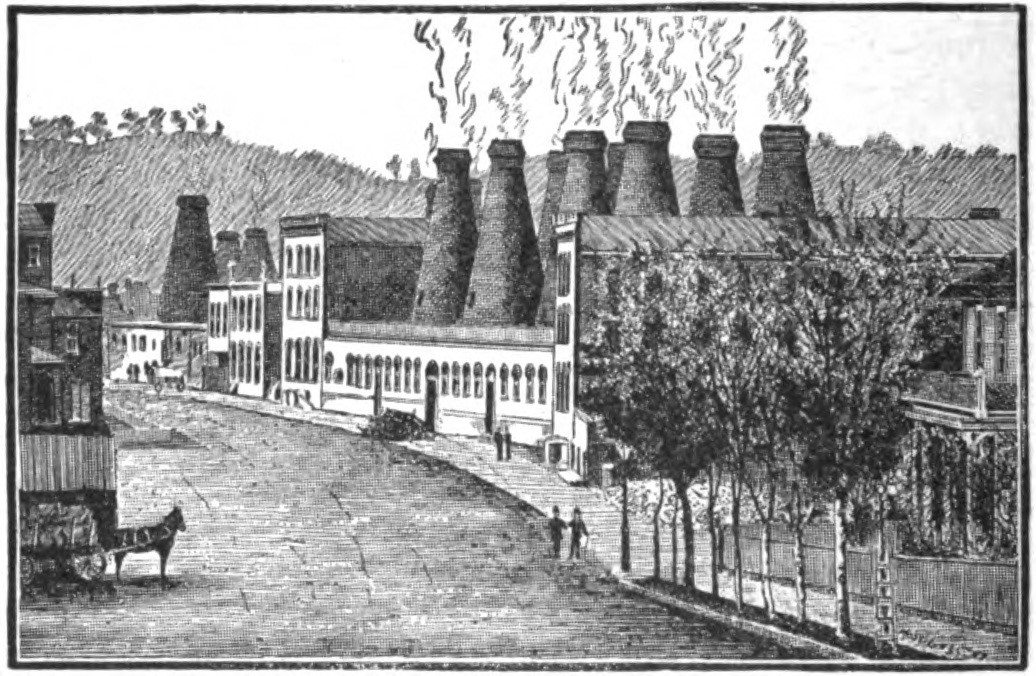
In 1840, James Bennett established East Liverpool’s first commercial pottery. Carnegie Public Library’s local history describes a small riverfront works with one kiln, where the early venture began. These supplied images put a face and a firing structure beside that story.
Historical context: Carnegie Public Library and Museum of Ceramics. Image dates are not recorded.
Pierced porcelain, floral decoration and gold accents reward a closer look. Open each owner-supplied photograph to explore the whole object and its attribution.